
Rapid Recovery Breast Augmentation
Conveniently located to serve St. Louis, Missouri
Jump To:
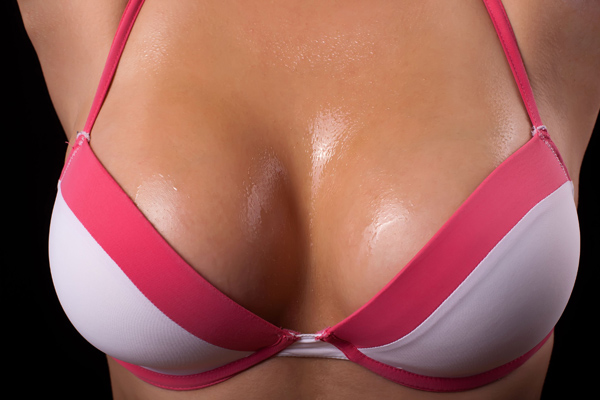 A breast augmentation is a procedure in which either a silicone or saline implant, or a patient’s own fat, is used to augment the breast. This procedure usually takes anywhere from 1 ½-2 hours to perform and is generally done under general anesthesia. Dr. Cabbabe utilizes “Rapid Recovery” or “Flash recovery” techniques to minimize pain and down time after surgery. These involve use of anti-inflammatories and local anesthetics around the time of surgery, careful surgical technique to minimize bleeding and early range of motion after surgery to allow the fastest recovery possible.
When an implant is used, the implant can be placed through one of three different incisions: The incision can be around the areola, which is the pigmented area near the nipple, in the natural breast fold, or occasionally through the armpit. Under the breast is the most common location recommended unless a breast lift is also being performed. The breast crease is often times intentionally lowered when placing a larger implant. This allows the scar to sit in the new breast crease for the implant, instead of on the lower half of the breast in the old breast crease. Placing the implants through the areola carries a higher risk of developing a capsular contracture and can affect a woman’s ability to have a breast lift safely later. If a breast lift is being done those incisions that are used to make the breast lift will be utilized to insert the implant. If fat is being injected, very small incisions are made, through which fat is injected after liposuction is done.
Implants may be placed above or below the muscle. Implants placed above the muscle carry a higher risk of capsular contracture, or encapsulation, than below the muscle. This risk is also higher in nicotine users, or if a lift is being done. For this reason, below the muscle is usually recommended. Most implants placed in this manner are done in a “dual – plane”, below the muscle in the upper half of the breast and below the breast gland in the lower half of the breast. This allows the implant to sit in a more natural position under the muscle and breast with ideal nipple position. Exceptions may include body builders or other patient’s not desiring any movement of the implant with muscle tightening.
Dr. Cabbabe performs hundreds of implant surgeries each year and uses only FDA – approved breast implants. These come with various warranties in case of rupture/leaking or capsular contracture.
The current choices for a breast implant are silicone and saline. A silicone implant has a silicone shell with silicone material inside. A saline implant is composed of a silicone shell with saline or salt – water inside. Silicone implants are available as round or “shaped”/gummy bear”. Round implants may be smooth or textured, whereas shaped implants are always textured to prevent implant rotation. Allergan textured implants have been recalled due to concern for ALCL. The concern for ALCL is due to the textured implant surface allowing bacteria to adhere more easily. For this reason, Dr. Cabbabe uses primarily smooth round implants in his practice. Newer round implants are incorporate the thicker/more cohesive silicone to provide better form stability in the breast, less rippling and more upper pole fullness.
In Dr. Cabbabe’s opinion, a silicone implant tends to provide a more natural look and natural feel with less rippling and more upper pole fullness than a saline implant. Current FDA recommendations state that women <22 years of age should receive saline implants; otherwise, any woman can choose which implant they prefer. FDA recommendations are for MRI screening 2 years after augmentation then every 3 years thereafter. This is to detect silent ruptures of the implant which may require further surgery. These are recommendations, not requirements and Dr. Cabbabe will review his opinion on this recommendation with you at the time of your consultation. The expected life of an implant is approximately 15 years. If a saline implant ruptures and it will generally deflate the breast and one would be able to tell immediately. If a silicone implant ruptures, the patient may not know, or they may feel a small bubble or some other sort of contour change or maybe some local irritation or discomfort. A rupture may produce a capsular contracture of the breast, resulting in a hard or misshapen breast. Either way, it is recommended that the implants be replaced if ruptured and, if the implants are several years old, both implants will be replaced at the same time. We purchase our implants with lifetime warranties so that if this occurs the company will pick up the cost for the implants themselves for the lifetime of the implants. They will even give money towards surgical fees if this occurs in the first 10 years after placement. Implant companies now warranty for capsular contracture as well for the first 2 years.
Videos
Preparing for Surgery
Dr. Cabbabe will ask that you refrain from taking any aspirin, Plavix, Coumadin, ibuprofen or any other type of blood thinner before surgery. If you are older than 40, a mammogram within one year prior to the procedure is recommended as part of normal health screening. You will have an opportunity to try implants of various sizes inside a bra which will help you determine which size implant is best for you. Dr. Cabbabe will also measure your chest width to help you determine the best fit and shape for you. Dr. Cabbabe excels at making recommendations based on a patient’s desires and tissue characteristics. He is not a “one size fits all” surgeon and may recommend various types of implants to provide the best result possible.
Candidates
A good candidate for a breast augmentation procedure is anyone who desires to have more fullness or enhancement of their breasts. If the breast is significantly ptotic or droopy, a breast lift may be recommended as well. If a patient is large breasted, a reduction may be done at the type of implant placement. Dr. Cabbabe does not hesitate to recommend a breast lift for any patient with excess skin or droopiness of the breast. He feels strongly that doing a breast lift helps to reshape the breast, allows the implant to sit higher on the chest wall with a better shape and positions the nipple – areola better over the implant. If no lift is done, the implant will settle to the lowest point of the breast and there will be no upper pole fullness and eventually the implant will start to fall into the armpits when lying down. These present challenging revision cases as new pockets will need to be made and a lift will be needed.
An unreasonable expectation would be to place a larger implant to avoid a breast lift. This exacerbates the situation because the heavier implant will stretch the skin further and accelerate the changes discussed above.
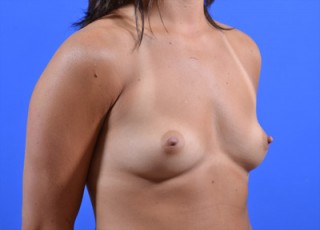
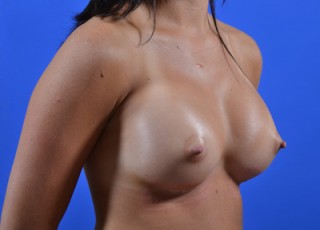
Before & After Gallery
View before-and-after pictures of real patients of Cabbabe Plastic Surgery
Surgery
Prior to surgery, patients are given an anti-inflammatory, anti-nausea medicine and antibiotics. Long-acting local anesthesia is placed in the surgical areas to reduce pain after surgery. An implant surgery is usually 1-1.5 hours and a lift adds about 1 additional hour. capsular contracture as this is not considered as “clean” as under the breast.
If a saline implant is used occasionally, they can be inserted through the armpit if one doesn’t desire any incisions on their breast at all. Most of the time the implants are placed underneath the muscle to reduce the risk of capsular contracture and rippling.
Breast augmentation surgery is done under general anesthesia and takes around 1 – 1 1/2 hours to complete. Doing a breast lift adds an additional hour or so. Using the “Rapid Recovery” or “Flash Recovery” Techniques patients are given anti-inflammatories and Tylenol to “block pain before it starts” prior to surgery. During surgery, local anesthetics/numbing medicine is used in the skin and muscle to reduce pain after surgery. Antibiotics are given before the procedure, generally no drains are used, and massaging is generally recommended for most patients. Patients are able to shower the next day and go home in a bra. Use of anti-inflammatories in encouraged after surgery as the primary pain medication. Early range of motion is done with the arms. Patients will generally follow-up within 1 day to 1 week and then approximately 3-4 weeks later and then in several months.
The implants will sit higher on the chest immediately after surgery and will then settle into the breast over the course of 3 months to 1 year. A bandeau may be provided to help accelerate the natural settling of the implants that occurs after surgery.
Nipple sensation and the ability to lactate are usually preserved in these procedures. Women are able to get mammograms after surgery and implants do not interfere with breast cancer detection.
Your Rapid Recovery Breast Augmentation will be performed in a hospital or surgery center in St. Louis, MO.
Recovery
Recovery is approximately 1-2 weeks from a breast augmentation procedure depending on the size of the implant used and the type of work one does. Most women who have this procedure done will be up and about the next day, moving around although they may need pain medication occasionally, but most women state it was not as bad as they anticipated and most of them, if they’ve had it done on a Thursday or Friday, can usually return to work the following Monday. Ibuprofen is the primary pain reliever, although narcotics and/or Valium may be prescribed.
Dr. Cabbabe strives to make the procedure as easy and comfortable as possible for his patients. Dr. Cabbabe does not believe in the use of pain pumps for breast augmentation because newer local anesthetics are long acting and have eliminated the need for these pumps. Studies have shown mixed results with pain pumps: they are costly, and they can increase the risk of infections. Dr. Cabbabe has removed breast implants on patients from other practices that use pain pumps due to infection.
Complications
The complications that can occur are implant infections, bleeding after surgery, capsular contracture and asymmetries. Infections are rare after augmentation and could require implant removal to treat. Any significant bleeding requires additional surgery to remove the blood, otherwise capsular contractures may occur. Most women have some asymmetry to their breasts and most of the time the same sized implant is used on both sides but occasionally a different size implant will be used if needed. More significant asymmetries need to be addressed through further incisions on the breast in the form of a breast lift. Capsular contracture is a known risk that can be reduced, but not eliminated, by placing the implant below the muscle. Massaging helps reduce the risk of this occurring and this is often warrantied for the first 2 years. An implant will eventually rupture, and further surgery would be needed during their lifetime. Lifetime warranties are usually purchased for this reason; the implants will get replaced but there may be additional surgical costs to the patient.
ALCL
There is a rare form of breast – implant associated lymphoma which all patients need to be aware of. This is believed to be related to bacteria/biofilm on the implants. It is now understood that the vast majority of these cases involve “textured” implants, with Allergan being the predominant implant associated. To date, there are no cases when only smooth implants have been utilized. For this reason, Allergan recalled all of their textured implants off the shelves in 2019. Allergan and the FDA do not recommend preventative implant replacement or capsulectomy because ALCL may still occur despite these measures.
ALCL becomes visible 5-10 years after surgery, most commonly with fluid collecting acutely around the implant. Although fluid can accumulate for non – cancerous reasons, fluid collecting around the implant may need to be tested for cancer cells prior to performing implant replacement surgery, particularly if it falls within this time range. If ALCL is detected, implant removal and capsulectomy are recommended. If ALCL is caught early, this surgery may be curative. If it is caught late, more aggressive treatment such as chemotherapy or radiation may be recommended by an oncologist. Dr. Cabbabe recommends routine follow up annually to examine the implants for any abnormalities and to contact him immediately if there are any changes or concerns.