
Medial Thigh Lift
WHO BENEFITS FROM A THIGH LIFT
Patients who experience significant weight loss, lifelong thigh fullness, or prior aggressive thigh liposuction often develop excess skin and soft-tissue bulk in the thighs. This can lead to discomfort, chafing, difficulty with clothing, and cosmetic dissatisfaction. Excess tissue may involve the upper inner thighs, extend toward the knee, affect the outer thighs, or— in more severe cases—extend toward the calf.
Patients who have undergone overly aggressive inner-thigh liposuction elsewhere frequently develop thin, damaged, excess skin that cannot retract. These patients are often excellent candidates for a properly executed thigh lift to restore contour and function.
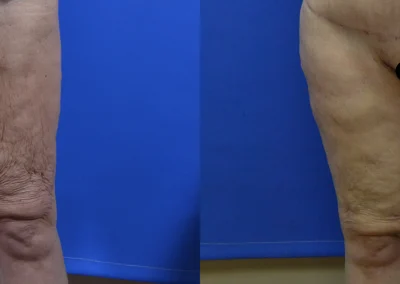
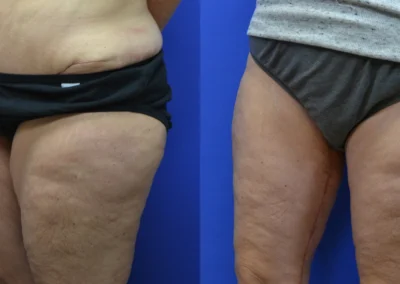
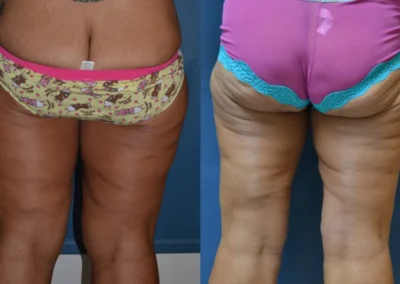
IMPORTANT WARNING ABOUT CIRCUMFERENTIAL THIGH LIFTS
A circumferential thigh lift limited to the groin—especially those extending partially toward the buttock crease—is rarely an effective solution for most patients. Contrary to outdated textbooks and techniques, circumferential groin-based thigh lifts do not adequately remove excess upper inner-thigh skin and place excessive tension in the groin.
Even when “anchoring sutures” are used, this approach does not reliably prevent labial spreading or scar migration. We see this routinely in revision patients. Once labial spreading occurs from groin-only circumferential thigh lifts, it can be catastrophic and, in some cases, extremely difficult or impossible to fully correct.
A THIGH LIFT IS OFTEN MISUNDERSTOOD
A thigh lift is commonly misunderstood as a purely vertical lifting operation. In reality, it is primarily a skin-excision and contouring procedure designed to remove excess tissue—most effectively along the inner thigh—while reshaping and refining the thigh as a whole.
True vertical elevation of the thigh is achieved through other procedures, such as a lower body lift and/or posterior thigh lift. For patients seeking comprehensive thigh elevation, these techniques may be required in combination.
COMPREHENSIVE LIFTING APPROACH
Total thigh reshaping often requires a combination of techniques tailored to the individual patient, including medial thigh lifting, lower body lifting, and posterior thigh lifting to address the front, inner, and back of the thighs as needed.
These procedures must be performed in the correct sequence and with a deep understanding of skin behavior, tension vectors, and lymphatic preservation. Patients benefit most from a surgeon with extensive experience across all aspects of body contouring and skin excision to minimize complications and reduce the need for revision surgery.
LIPOSUCTION / CONTOURING & THIGH LIFT INTEGRATION
In our practice, a thigh lift is never “just skin removal.” We routinely contour the thigh, hip, and knee regions during surgery to address bulk and improve shape—areas that are often ignored when surgeons focus only on excision.
Fat removed during thigh contouring may be transferred to other areas, such as the buttocks (Brazilian butt lift) or breasts (fat transfer to the breast), when appropriate. This comprehensive approach produces more balanced, natural results and is a key reason many patients seek revision after simpler thigh lift techniques performed elsewhere.
In patients with very thick thighs or lipedema, staged debulking liposuction may be recommended before skin excision to improve safety and results.
SCAR DESIGN & PLACEMENT
The thigh lift scar is placed along the inner thigh and curves naturally into the groin crease in a smooth, J-shaped pattern. It is intentionally hidden when standing and avoids visibility on the front of the thigh.
Scars that migrate onto the anterior (front) thigh—rather than remaining concealed in the groin crease—are a common cause of dissatisfaction and revision requests. A T-shaped incision is not used unless a posterior thigh lift is also required.
RECOVERY & AFTERCARE
Thigh lift surgery is typically an outpatient procedure when performed alone and is often combined with lower body lifting for optimal results. We perform thigh lifts without drains using lymphatic-sparing techniques. Complications are uncommon and may include small lymphoceles (often less than 5 mL) that can be easily aspirated in the office.
Patients are placed in compression garments that extend past the knees, and leg elevation is strongly encouraged for the first one to two weeks. Discomfort is most noticeable during the first week. Most patients can begin light activity at 3–4 weeks. Scar maturation continues for over a year.
WHY EXPERIENCE MATTERS
Thigh lift surgery has one of the highest complication rates when performed by low-volume surgeons. Poor technique can result in large wounds, chronic swelling, contour deformities, and the need for major revision surgery.
Dr. Cabbabe is a high-volume thigh lift and lower body lift surgeon who lectures internationally on advanced body contouring. These procedures require meticulous attention to detail—small technical decisions directly determine whether patients heal well and achieve the best possible outcome for their anatomy. This is where experience makes the greatest difference.
IMPORTANT CONSIDERATION REGARDING SKIN QUALITY
Skin quality ultimately limits what surgery can achieve. Patients with poor skin quality, severe upper inner-thigh excess, or prior tissue damage may occasionally require secondary revision procedures. When needed, these are often minor and can frequently be performed safely in the office.
Maximizing results while respecting the limitations of each patient’s skin is central to achieving durable, natural outcomes.