Posterior Thigh Lift / Buttock Fold Reshaping
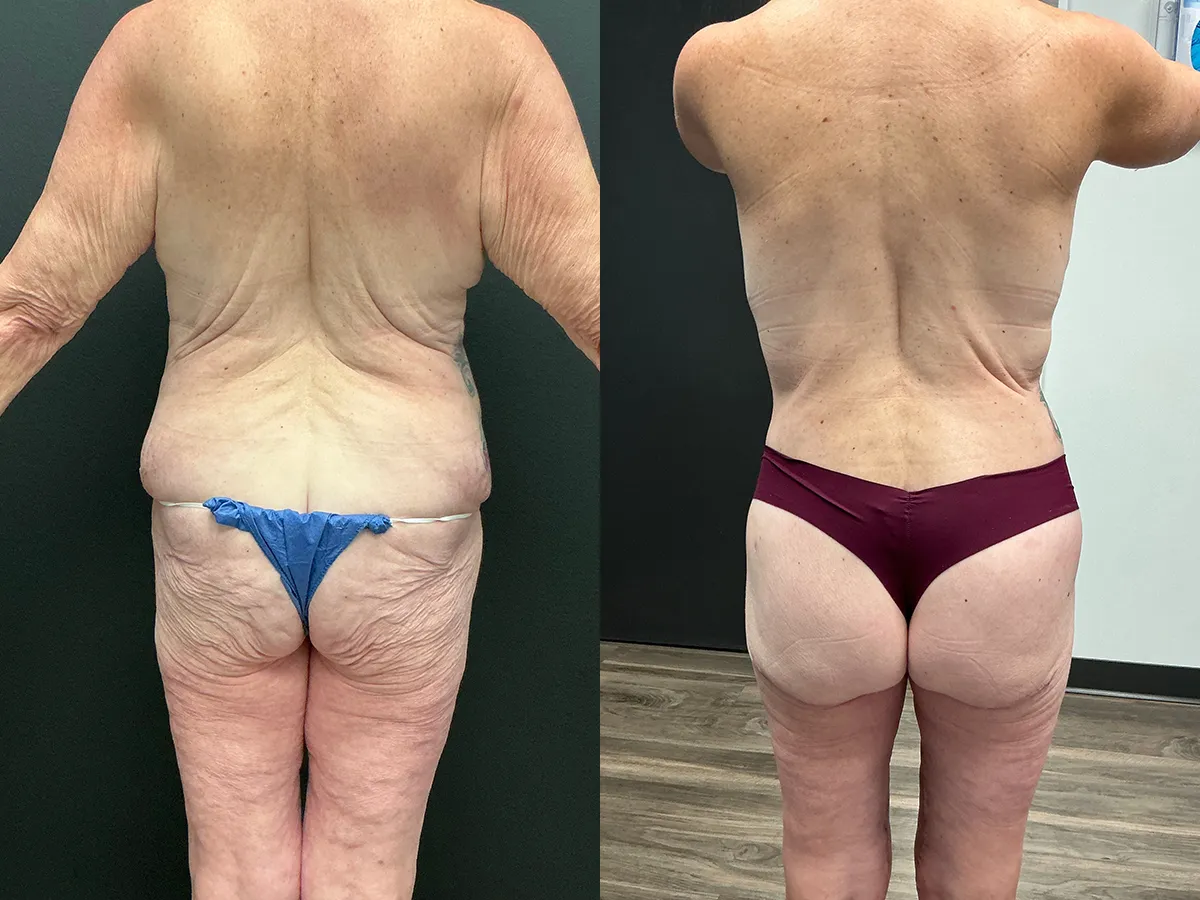
A posterior thigh lift—also referred to as buttock fold reshaping—is designed to tighten, contour, and reshape the junction between the buttocks and the upper posterior thighs. This procedure addresses laxity, deflation, and excess skin beneath the buttocks and along the back of the thighs, improving contour, support, and definition of the lower buttock crease.
Patients who benefit from a posterior thigh lift include those who have experienced significant weight loss, age-related skin laxity, or lifelong looseness in the buttock–thigh junction. In addition, patients with low buttock volume—regardless of BMI—are candidates, including low-BMI patients who desire improved buttock shape and projection but lack adequate volume.
Integration With Contouring, Liposuction, and Fat Transfer
Posterior thigh lifting in our practice is integrated with advanced liposuction and contouring of the buttocks, hips, posterior thighs, and transition zones when indicated. In patients who lack buttock projection, fat transfer to the buttocks (Brazilian butt lift) may be incorporated to restore volume and improve the buttock–thigh relationship.
This combined approach allows reshaping—not just tightening—of the buttock fold and posterior thigh. Attention to contour is critical, as many surgeons focus only on skin excision and fail to address underlying shape, which can lead to visible irregularities and unnatural results.
Patients seeking posterior thigh lifting may have previously undergone liposuction elsewhere. Overly aggressive or improperly performed liposuction—particularly in incorrect tissue planes—can damage the skin envelope and create deformities. This is one of the most common reasons we see patients seeking revision surgery. When liposuction is required, it is best performed by the same surgeon performing the lift to ensure proper technique, tissue preservation, and optimal outcomes.
Standalone vs. Comprehensive Lifting Approach
A posterior thigh lift can be performed as a standalone procedure in appropriately selected patients. In these cases, it effectively reshapes the buttock fold and posterior thigh without the need for additional lifting procedures.
Depending on anatomy and goals, posterior thigh lifting is also frequently performed as part of a comprehensive lifting approach. This may include lower body lifting and/or medial thigh lifting to address the front, inner, and back of the thighs together. Many patients benefit from combining these procedures in a single operation, while others achieve better outcomes with a staged approach. These decisions are individualized and discussed in detail during consultation.
Surgical Technique and Scar Placement
The incision for a posterior thigh lift is precisely placed within the natural buttock crease, allowing the scar to be well concealed beneath the buttocks while minimizing visibility on the hip or lateral thigh. The goal is to reshape and support the buttock–thigh junction while preserving natural contours.
This procedure tightens and reshapes tissue rather than creating vertical “pull” of the thigh. While tightening improves the appearance of loose or damaged skin, it does not completely eliminate cellulite or fine wrinkling, particularly around the knees.
Experience Matters
Posterior thigh lifting is technically demanding and associated with significantly higher complication rates when performed by low-volume surgeons. These complications can be substantial and include wound problems, prolonged swelling, contour deformities, and the need for major revision surgery.
Dr. Cabbabe is an international authority and high-volume surgeon in posterior thigh lifting, lower body lifting, and advanced body contouring, and frequently lectures on these topics. The small technical details—incision placement, tension vectors, tissue handling, and contour integration—are critical not only for healing, but for maximizing results for each patient’s anatomy and minimizing the need for revision.
Recovery and Expectations
Posterior thigh lift surgery is typically performed as an outpatient procedure. Most patients experience moderate discomfort during the first week, with steady improvement thereafter. Light exercise can often begin within a few weeks, depending on the extent of surgery and whether additional procedures are performed. Scar maturation continues for a year or longer, with progressive softening and fading over time.
Important Considerations Regarding Skin Quality
Patients with poor skin quality, thin or damaged skin (often from prior aggressive liposuction) should understand that outcomes are inherently less predictable. In these cases, small secondary revisions may occasionally be required due to limitations of the skin itself. When necessary, these refinements can often be performed in the office setting.